I Stopped Walking (Why Movement Is Holding You Back)
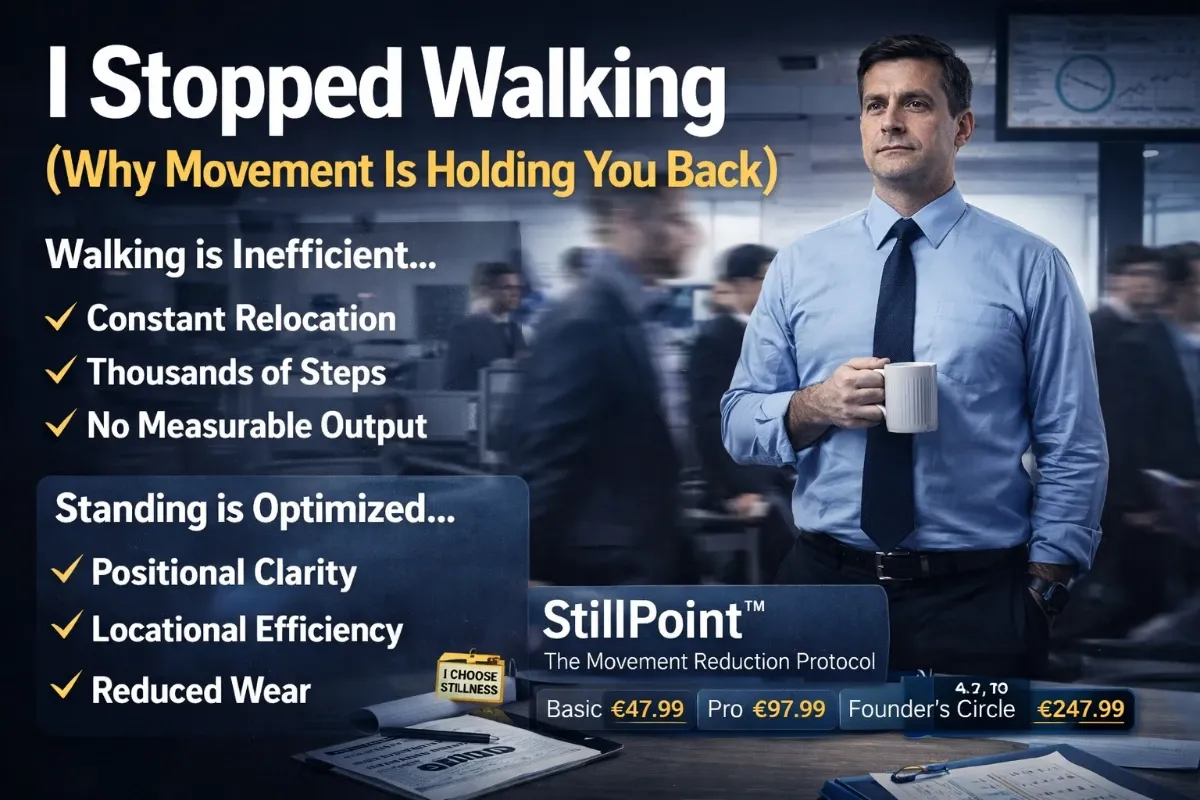
For years, I did what everyone else does.
I walked.
To the kitchen.
To the shop.
Around the block for no clear reason.
Thousands of steps a day, taken automatically, without question.
Because that’s what we’re told, isn’t it?
“Get your steps in.”
“Stay active.”
“10,000 a day.”
No one ever stops to ask why.
The Moment Everything Changed
It hit me halfway through a completely unnecessary trip to the kitchen.
I wasn’t hungry.
I wasn’t thirsty.
I was just… walking.
That’s when I realised:
Most people don’t move with intention.
They drift.
Step by step, task by task, burning time and energy without ever asking whether the movement is required.
So I stopped.
Completely.
No casual walking.
No pacing.
No “just popping over there”.
If I couldn’t justify the movement, I didn’t make it.
Days 1 - 2: The Withdrawal Phase
The first 48 hours were uncomfortable.
My body, conditioned to constant low-level movement, began to react:
- restlessness
- an urge to “go somewhere”
- legs feeling… underutilised
Classic signs of locomotion dependency.
This is where most people quit.
They put their shoes on.
They check their step count.
They go for a “quick walk”.
I stayed exactly where I was.
Days 3 - 4: Positional Awareness
Something shifted.
The urge to move began to fade. My body stopped expecting constant relocation and started adapting to stillness.
I wasn’t inactive.
I was stable.
I began to notice things:
How often I used to move without purpose.
How many steps were taken out of habit rather than necessity.
How inefficient my previous patterns had been.
I’d entered a state of positional awareness.
Days 5 - 6: The Efficiency Window
This is where the benefits became measurable.
Without unnecessary movement, my day simplified:
- no wasted trips
- no step-count anxiety
- no time lost to aimless pacing
I stopped “going places”.
I positioned myself.
Everything I needed was either within reach or… not essential.
Even the idea of walking began to feel excessive.
Day 7: The Realisation
Walking isn’t just movement.
It’s a system.
A deeply embedded behavioural loop that keeps people in a constant state of low-level activity without ever questioning the purpose.
And once you see it, you can’t unsee it.
The Bigger Picture
Think about it.
Why is walking everywhere?
Step counters.
Fitness apps.
Wearables tracking your every move.
Daily targets that reset if you don’t comply.
Who benefits from you constantly moving?
Follow the steps.
What I Learned
By removing unnecessary walking, I discovered:
- how much time is lost to automatic movement
- how rarely people question physical habits
- how powerful it is to stay exactly where you are
My legs still function.
I’ve simply chosen not to use them unnecessarily.
Should You Try It?
I’m not here to tell you what to do.
Most people aren’t ready for this level of change.
They’ll read this, stand up, and go for a walk.
And that’s fine.
Movement is comfortable.
For Those Who Are Ready
If you’re serious about reducing unnecessary locomotion, I’ve developed a structured system:
StillPoint™: The Movement Reduction Protocol
Inside, you’ll discover:
- the 3-stage Locomotion Detox
- how to calculate your Locational Efficiency Index (LEI)
- my framework for strategic positioning
- controlled micro-relocation techniques (advanced)
Available Programmes
Basic: €47.99
Pro (with standing endurance module): €97.99
Founder’s Circle (includes signed waiver & “I Stayed Put” enamel pin): €247.99
Access is currently open for a limited time.
Disclaimer: Results may vary. Walking remains widely practiced.
StillPoint™ is not medical advice, legal advice, or movement.