Why I’ll Take "Socialist" Healthcare Over the American "Freedom" to Go Bankrupt
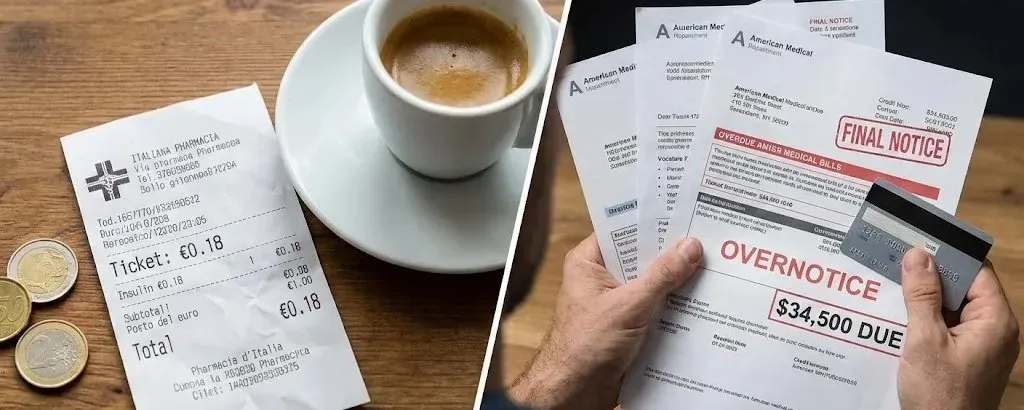
I recently watched a video of a woman in Louisiana crying because she can no longer afford her insulin.
Between sobs, she blamed "handouts" to poor people and "crackheads" for her plight.
It was a tragic display of cognitive dissonance: a woman being fleeced by a system she continues to vote for, blaming the poorest in society while Donald Trump and the party she supports protect Big Pharma’s profits at the cost of her life.
As a British expat living in Northern Italy, watching the American healthcare "debate" is like watching a different planet.
To help my American friends understand why we aren't "oppressed" by our social services, here is what life actually looks like under a functioning national health system in 2026.
The "Family Doctor" Myth
Americans often claim we wait months just to see a GP. In my village, my Medico di Base (family doctor) is available Monday to Friday.
The Access: If I’m ill, I walk in and wait twenty or thirty minutes. If it’s not urgent, I can call, text or email her. I usually get an appointment the same or next day.
The Cost: €0.
The Quality: She is a brilliant Ukrainian doctor who knows my history. I don’t have to check if she’s "in-network," and she doesn't have to ask an insurance company for permission to treat me.
The "Priority System" for Specialists
When I need a specialist or an ultrasound, I don't just sit on a list forever. Italy uses a very logical "Priority Code" system. My GP writes the prescription, and the wait depends entirely on how much trouble I’m in.
I contact a central booking system by phone, normally a 3 to 5 minute wait, and depending on the urgency the waiting time is from 3 to 120 days.
If I’m in a desperate hurry for a non-urgent issue, I can choose the "private" route and see the exact same specialist within 48 hours for a flat fee of €60 to €100. That’s often less than an American’s "co-pay" just to get in the door.
Chronic Illness: Where the System Shines
The Exemption: Because I have a chronic illness, I am exempt from almost all costs. Italy has a list of 59 chronic conditions, ranging from diabetes and asthma to heart disease, where the state covers 100% of the cost. I pay zero for my blood tests, my yearly check-ups, my insulin and my test strips etc.
The "Ticket": For unrelated issues, like having the skin lesion I had frozen off recently, I paid a "ticket" (participation fee) of just €27. No $5,000 deductible to meet first. No surprise bill for $400 because the lab was "out-of-network."
The Reality of Surgery
This is the part the Americans shout about: "You have to wait for surgery!"
Yes, we do. But context matters.
Emergency Surgery: If your appendix bursts or you have a heart attack, you are in the operating theatre within hours. It is immediate, world-class, and costs €0.
Elective Surgery: For a hip replacement, a hernia, or cataracts, you might wait 3 to 12 months.
The Trade-off: I would rather wait six months for a new hip than spend six years paying for one.
In Italy, less than 20% of cataract patients wait more than three months. In America, you might get it tomorrow, but you’ll be paying for it until you’re dead.
In Italy, we have a "mixed" system. You are never "trapped" in the public system; you always have the option to go private if you’re in a hurry or want to choose a specific "Star Surgeon."
Here is how the private surgery side works
The Price Tag: Because the private sector has to compete with a high-quality "free" public system, the prices are kept remarkably low compared to the US.
A private hip replacement in Italy might cost you €12,000 - €15,000. In the US, the same surgery without insurance often starts at $30,000 and can go much higher.
The Speed: If you go private, the wait time for "elective" surgery (like that hip or a hernia) drops from months to days or weeks.
The "Convenzionato" System: Many private hospitals are actually "accredited" by the state. This means you can sometimes go to a fancy private clinic but have the bill picked up by the government if the public hospital has a backlog.
The Professional: Most top-tier surgeons work in the public hospitals during the day and have private "extramural" hours in the evenings. You can pay to see them privately for a consultation, and they can often schedule your surgery in the public hospital much faster if it’s deemed medically necessary.
Whether you go 'private' or public for the surgery itself, you can return to the state system for your post-op care. This means your Physiotherapy, pain meds, and follow-ups are effectively free (or cost just a standard 'ticket'). You don't get trapped in a private billing cycle for rehab.
Childbirth: A Gift, Not a Protection Racket
This is where the American system becomes truly ghoulish. I’ve read documented "horror stories" of American hospitals charging parents $39.35 for "Skin-to-Skin contact", literally charging a mother to hold her own newborn baby.
In Italy, we view that as a basic human right, not a billable service.
Prenatal & Birth: All scans, blood tests, and the birth itself cost €0.
The Reality: You leave the hospital with a baby and a sense of joy, not a $30,000 invoice and a bill for a hug.
And the support doesn't stop at the hospital door. All post-natal care, including home visits from midwives, your chosen paediatrician, and the full schedule of childhood vaccinations, is 100% free. We don't charge parents to protect their children from disease.
The Verdict
I’m not pretending Italy’s system is flawless. Funding’s tight, staff are overworked, and plenty of hospitals are crumbling and held together with duct tape, especially in the south of the country. But even at its worst, it’s still built on the simple, humane principle that healthcare shouldn’t depend on how lucky you are with your employer, or how many zeros you’ve got in your bank account.
The American system isn't a "Free Market." It’s a protection racket where lobbyists write the laws to ensure their profits. You are paying the highest taxes in the developed world for healthcare, and then you’re paying the insurance companies on top of that just to be told "No."
I paid 18 cents for my medication last month.
I can call an ambulance (which is free) without a credit card in my hand.
You call it "Communism." I call it being a member of a civilised society.
I’ll keep my "socialised" 18-cent meds and my extra decade of life expectancy, thanks.
You keep your "freedom" to die in debt.